ScaleChef Try it free

For professional kitchens · $49 once, not a subscription

Kitchen math that knows salt doesn’t scale like flour.

Scale recipes accurately, convert quantities intelligently, and turn a menu into a usable production plan.

Try it free Buy — $49

The free version is the real app — it loads a demo kitchen in one tap. No sign-up.

× 3.75 taste check

At large factors, salt gets flagged — not silently multiplied.

4,535.9 g → 4.54 kg

Every quantity comes back in a unit a cook can measure.

140 ÷ 30 → 5 × 28

Batches split evenly to your equipment — no lopsided last batch.

A spreadsheet multiplies. A kitchen doesn’t.

Naive multiplication is what every spreadsheet already does badly. ScaleChef makes the calls a calculator can’t — and every one of them is arithmetic you can check.

g → 30 g taste check

Salt, leavening and chili get flagged, not multiplied blind.

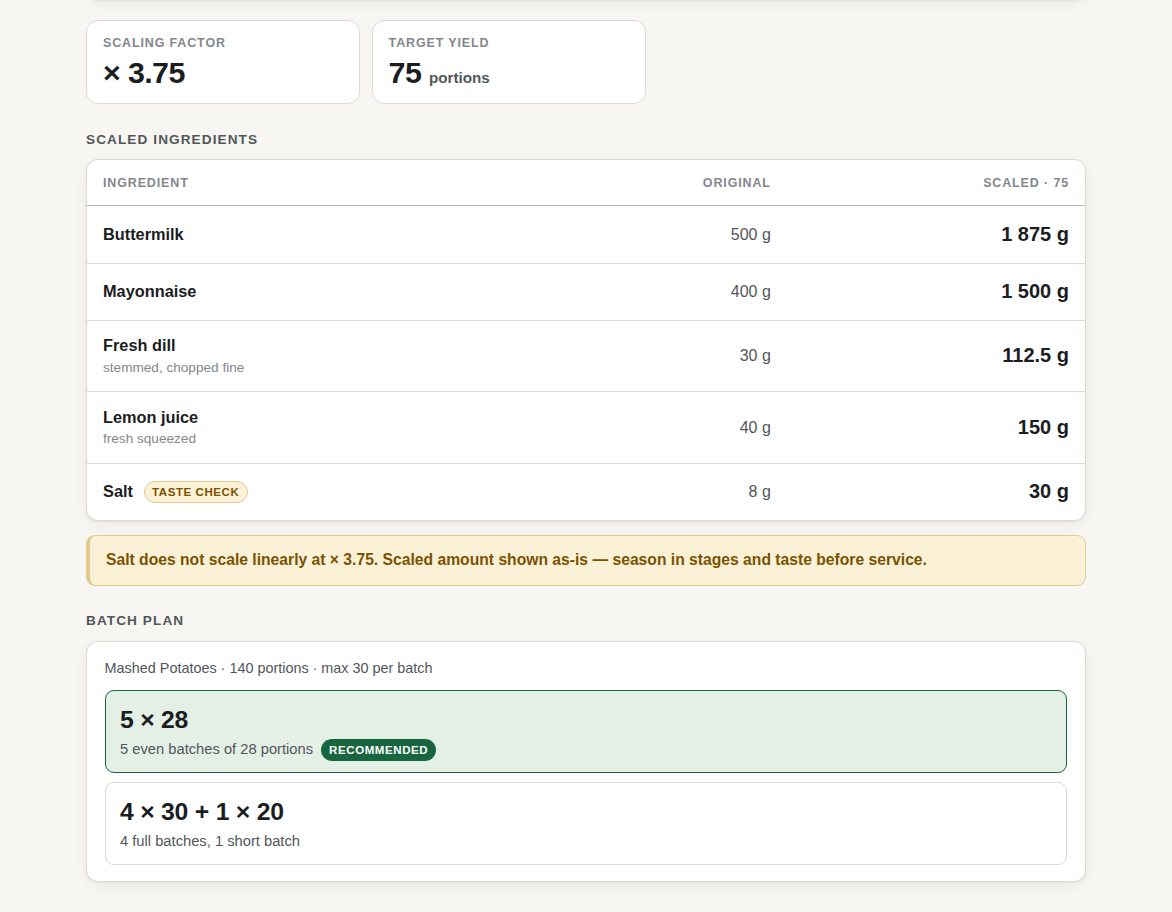
At ×3.75 ScaleChef flags the ingredients that don’t scale linearly and tells you to season in stages and taste. Scaling those straight is how a 10× batch gets ruined — and no calculator warns you.

128 tbsp → 8 cups

Units a cook can actually measure.

4,535.9 g becomes 4.54 kg. US volumes snap to the fractions a measuring spoon actually has, because 0.37 tsp is not a real instruction anyone can follow.

140 ÷ 30 → 5 × 28

Batches your equipment can handle.

140 portions of mash through a 30-portion mixer comes back as 5 even batches of 28 — not four full batches and one lopsided runt. Ingredient quantities are shown per batch, so the plan goes straight to the station.

10 lb EP → order 12.2 lb

It orders what you buy, not what you plate.

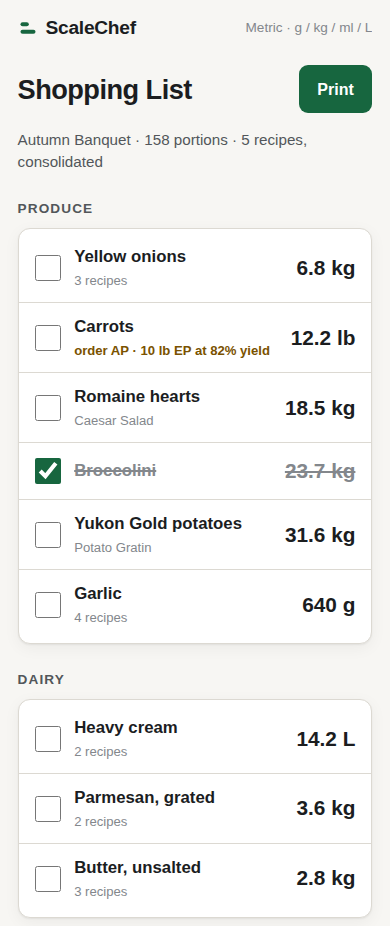
10 lb of cleaned carrots at 82% yield means ordering 12.2 lb. The shopping list carries the as-purchased number — and says so on the line, so nobody orders the trimmed weight by mistake.

One list for the whole menu

Garlic across five recipes becomes one number, grouped by section of the walk-in. Every line shows which recipes it came from, so a wrong number is auditable.

Paste a recipe instead of typing it

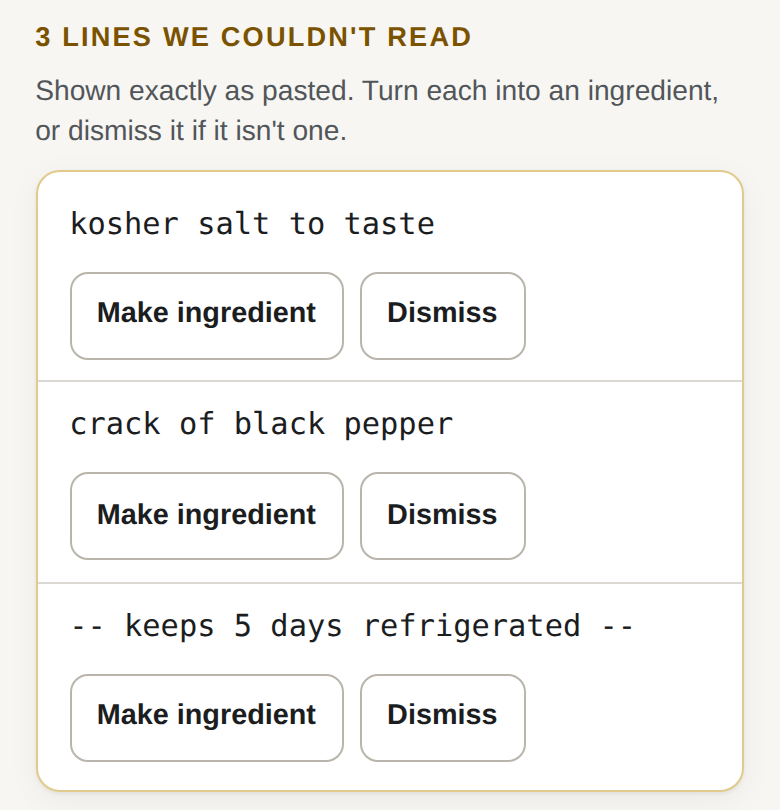
The importer reads recipes as pasted text. Anything it can’t read is shown to you to fix by hand — it never silently drops a line.

Rounding never compounds

All math runs on exact base units; rounding happens only on screen. Five batches is 5× the exact amount, not 5× a rounded one.

This is the app, not a mockup.

Every number below was produced by the engine — the same one you can try right now, free.

ScaleChef scale screen: Buttermilk Dill Sauce scaled by 3.75 to 75 portions. Salt carries a yellow taste-check badge; a warning reads that salt does not scale linearly at 3.75x. Below, a batch plan splits 140 portions of mashed potatoes into 5 recommended even batches of 28, with 4 by 30 plus 1 by 20 as the alternative.
The scale screen at ×3.75. Buttermilk multiplies clean; salt carries the taste-check flag with the reason spelled out. Underneath, 140 portions through a 30-portion mixer comes back as 5 even batches of 28.
ScaleChef shopping list for a 158-portion banquet across 5 recipes, consolidated and grouped into produce and dairy sections. The carrots line reads: order AP, 10 lb EP at 82 percent yield, 12.2 lb. Each line notes how many recipes it came from.
One list for a 158-portion banquet — five recipes consolidated, grouped by section of the walk-in. Carrots say “order AP”: 12.2 lb to buy for 10 lb cleaned. Every line names its recipes.
ScaleChef import review screen: a panel titled '3 lines we couldn't read' lists three pasted lines — kosher salt to taste, crack of black pepper, and keeps 5 days refrigerated — each shown exactly as pasted with buttons to make it an ingredient or dismiss it.
Paste a recipe, then check what was read. The three lines the parser couldn’t read are shown exactly as pasted, for you to fix or dismiss — never silently dropped.

$49. Once.

Not a subscription, and here’s why it doesn’t need to be. ScaleChef runs entirely on your own device. There is no server and no account behind it — so there is no monthly cost for anyone to pass on to you.

Buy it once and it’s yours. It installs to a phone or tablet home screen from the browser, and it works offline — in a walk-in with no signal, forever. Your recipes stay on your device and are yours to export.

Every number is plain arithmetic — no AI in the math — and the engine is tested against hand-computed values, including every worked example on this page.

$49one time

Yours on every device you install it on.

  • No subscription, no account. Nothing to sign up for.
  • Works fully offline. Install it to a home screen; a walk-in with no signal is the design case.
  • Your recipes live on your device. Export the whole book any time.
  • Scaling, conversion, batches, AP/EP ordering, events, shopping lists, printable prep sheets.

Built for production cooking.

Restaurants

Scale tonight’s prep from the master recipe in units the line can measure — instead of the phone calculator and a guess on the salt.

Banquets

150 guests plus a 5% buffer is 158 portions — set the count once and the whole menu scales together, warnings included.

Catering

One consolidated shopping list per event, grouped the way the walk-in is — print it and hand it to whoever is ordering.

Club kitchens

Print the prep sheet with per-batch quantities already worked out and tape it to the station for the morning crew.

Questions a chef would ask.

Does it work offline?

Yes, fully. It’s an installable web app: after the first load, everything runs on your device. No signal in the walk-in changes nothing.

Do I need an account?

No. There is nothing to sign up for and no server behind the app.

Where does my data live?

On your device. Recipes are stored in the browser’s local storage, and you can export the whole book as a file any time — for backup, or to hand your recipes to another chef.

Being honest: if you clear the browser’s site data, your recipes go with it. Export a backup once in a while.

Does it do food costing?

Not yet. The data model has a place reserved for ingredient cost, but nothing in the app prices a recipe today. If you’re buying it for costing, wait. Buy it for scaling, conversion, batch planning and ordering — that’s what it does now, and does well.

What if the importer can’t read part of my recipe?

It shows you every line it couldn’t parse, exactly as you pasted it, and you fix it by hand before anything is saved. An importer that quietly drops two ingredients out of fourteen is worse than none — so this one never drops a line.

Is there AI in the math?

No. Every number is plain arithmetic, tested against hand-computed values. The same input always gives the same answer — which is also why it can run free of accounts, servers and monthly fees.
Try it on your own recipe.

The free version is the full app with a demo kitchen loaded — scale something, split it into batches, build a shopping list. Then decide.